

Posted by Happy Home Shopping Guyana
on October 14, 2026

What if a calmer, easier-to-use kitchen starts with moving things around, not buying more storage? Learning how to organize a small kitchen can feel daunting when crowded counters leave little room to prep and cabinets are hard to navigate. A few thoughtful changes can make everyday cooking feel simpler.
If you’ve tried adding containers only to find the clutter still gets in the way, you’re not alone. The key is to organize around how your household cooks, then give frequently used items a convenient home. That way, the space supports your routine instead of adding extra steps.
This practical guide will help you start with decluttering, arrange essentials where you’ll reach for them, and make better use of cabinets, drawers, shelves, and wall space. You’ll also learn how to create useful cooking zones and keep the system manageable over time. Start with what you already have, and make each change count.
Key Takeaways
- Learn how to organize a small kitchen by spotting which areas and items slow down everyday cooking.
- Group tasks into practical zones so prep, cooking, serving, and cleanup feel easier, whatever your kitchen layout.
- Make better use of shelves, drawers, and cabinets before deciding whether an organizer would solve a real problem.
- Use a short daily reset to return tools, clear work surfaces, and keep food storage manageable.
- Choose kitchen tools only when they address a repeated task or storage challenge in your routine.
How to organize a small kitchen: start by understanding your space
A cramped kitchen can feel frustrating, but you don’t need to renovate to make it work better. Thoughtful placement can free up a useful patch of counter, make everyday tools easier to reach, and reveal storage you already have. Before moving everything around, take a little time to see what the space can do.
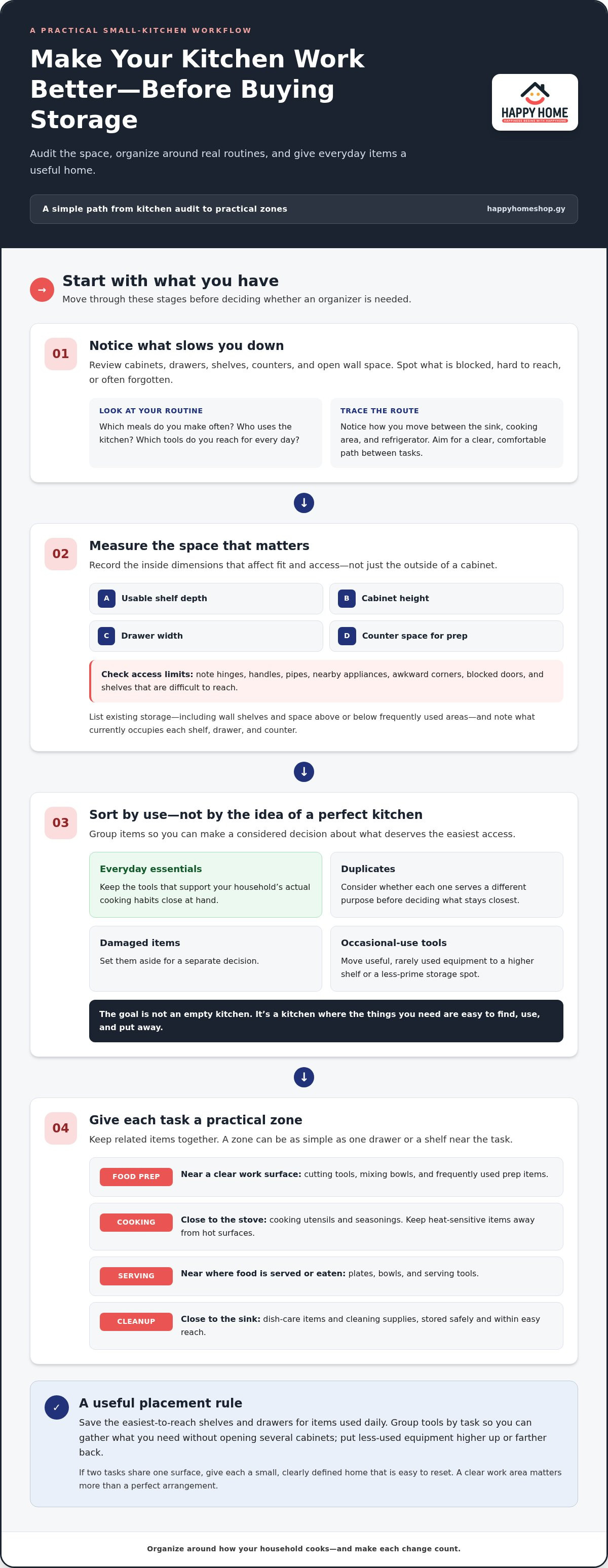
A small-kitchen audit is a quick review of your storage, cooking habits, and hard-to-use spots before you buy organizers. Start by looking at cabinets, drawers, shelves, counters, and open wall space. Notice what’s easy to access and what gets blocked or forgotten. Then think about your household’s routine: which meals do you make often, who uses the kitchen, and what tools do you reach for every day? These answers will help you organize around real needs rather than an idealized kitchen.
Pay attention to how you move between the sink, cooking area, and refrigerator. The kitchen work triangle describes the relationship between these common work areas. Your kitchen doesn’t need to follow a particular layout to benefit from a clear, comfortable route between tasks.
What should you measure before organizing a small kitchen?
Record the dimensions that affect what fits and how easily you can reach it. Measure usable shelf depth, cabinet height, drawer width, and the counter space you need to keep clear for food preparation. Check the inside dimensions, not just the outer cabinet, and note whether hinges, handles, pipes, or nearby appliances limit access.
- Mark awkward corners, blocked doors, and shelves that are difficult to reach.
- List existing storage, including wall shelves and space above or below frequently used areas.
- Note what currently occupies each shelf, drawer, and counter before shifting anything.
This simple record helps you spot unused space and avoid buying containers that won’t fit. It also helps you compare arrangements. A tall shelf may suit items used occasionally, while a shallow drawer may be better for tools you reach for every day.
How to declutter without discarding useful kitchen essentials
Decluttering doesn’t mean getting rid of everything you don’t use daily. Instead, group items by how often you use them and what condition they’re in. Separate everyday essentials, duplicates, damaged items, and occasional-use tools so you can make a thoughtful decision about each group.
Keep the tools that support your household’s actual cooking habits. If you regularly prepare vegetables, for example, a prep tool deserves an accessible home near your work area. A dedicated spot for a frequently used item, such as the Yusshn 12 IN 1 Vegetable Chopper, can make it easier to put away after use and keep prep space clear.
For duplicates, consider whether each one serves a different purpose before deciding what stays closest at hand. Set aside damaged items for a separate decision, and move useful but rarely used equipment to higher shelves or another less-prime storage spot. The goal is not an empty kitchen. It’s a kitchen where the things you need are easy to find, use, and put away.
Create practical kitchen zones for cooking, prep, and cleanup
Kitchen zones make a compact room easier to use by keeping related items together. You don’t need a particular layout or separate counters for every task. A zone can be as simple as one drawer for prep tools or a shelf near the sink for dish-care supplies. The aim is to reduce unnecessary steps and make it clear where things belong after use.
Think about the full path of a meal, from preparing ingredients to washing up. Assign items to the spot that best supports each task, even if your zones are small or share a surface. A clear work area matters more than a perfect arrangement.
- Food preparation: Keep cutting tools, mixing bowls, and frequently used prep items near a clear work surface when the layout allows.
- Cooking: Store the utensils and seasonings you reach for while cooking close to the stove, while keeping heat-sensitive items away from hot surfaces.
- Serving: Place plates, bowls, and serving tools near where food is served or eaten, so setting the table doesn’t require crossing the kitchen repeatedly.
- Cleanup: Keep dish-care items and cleaning supplies close to the sink, stored safely and within easy reach for the people who use them.
For a wider look at useful equipment, the kitchen supplies guide offers ideas to consider alongside your everyday routine.
How to arrange a kitchen for a smoother cooking routine
Start with the tasks you repeat most. If you prep ingredients on a counter beside the sink, keep a chopping board and prep tools nearby rather than across the room. Put cooking utensils in a drawer or container close to the stove, and group serving dishes near the dining area if that suits your layout. Store cleaning cloths and dish-care supplies near the sink. If two tasks share one surface, give each a small, clearly defined home that’s easy to reset.
Where should everyday items go in a small kitchen?
Save the easiest-to-reach shelves and drawers for items used daily. Group tools by task, such as baking, meal preparation, or making drinks, so you can gather what you need without opening several cabinets. Less-used equipment can go higher up or farther back, leaving prime spots free for everyday essentials.
A frequently used vegetable chopper should have a dedicated, accessible place near the prep zone, whether that’s a suitable cabinet shelf or a drawer with enough room. Returning it to the same spot makes the routine easier to maintain. Once your zones reflect how you cook, explore practical kitchen tools when a tool would meet a real need.
Do you need more organizers to make a small kitchen work?
Not necessarily. A small kitchen doesn’t automatically need more containers, racks, or dividers. Extra products can take up room or make everyday items harder to reach if they don’t solve a specific problem. First try adjusting what you already have: clear a shelf, group related items, or move occasional-use equipment out of prime storage. Add an organizer only if the same storage difficulty remains.
Judge a solution by how well it helps you see, reach, and safely return what you use. A shelf riser is useful if it makes items easier to access, not if it creates another crowded layer. A drawer divider earns its place if it keeps utensils from tangling, while a hook is helpful only if hanging items won’t obstruct a work area or walkway. Fit matters too: measure the space and consider whether cabinet doors and drawers can still open fully.
Use this quick comparison to match the problem to a simple first step:
- Unused height inside a cabinet: Rearrange the shelf or try a shelf riser to make the space easier to see and use.
- Mixed utensils are hard to find: Group them by task first. If they still shift around, consider a drawer divider that fits.
- A frequently used item has no home: Clear a stable, reachable spot near where you use it before adding a hook or holder.
- Items are stacked out of sight: Reorder them so daily essentials sit in front and occasional-use items are farther back.
When are shelf risers, hooks, or drawer dividers useful?
Try a shelf riser when cabinet height is going unused and the added level won’t hide items behind it. Use hooks only where hanging tools stay easy to reach and clear of counters, appliance doors, and walkways. Drawer dividers are worth considering when utensils repeatedly become mixed together and simple regrouping hasn’t made them easy to find.
How can you use vertical and hidden storage safely?
Wall space and the inside of a cabinet door can hold light, frequently used items, provided they don’t block doors, switches, or movement through the kitchen. Keep heavy cookware low and stable rather than overhead, and don’t overfill shelves. Avoid placing everyday essentials behind rarely used items. Having to unload a stack just to reach one tool makes storage less convenient.
Before keeping any new organizer, test the arrangement during an ordinary cooking routine. Can you reach what you need without shifting several other things? Does everything have enough room to be returned easily? If not, simplify the setup or try a different placement. The goal of how to organize a small kitchen isn’t to fit in the most organizers. It’s to make your storage visible, accessible, stable, and suited to daily use.
Keep a small kitchen organized with simple daily habits
A kitchen stays easier to use when tidying is part of the cooking routine, not a separate household project. A brief reset after preparing a meal can return tools to their places, clear the surface for the next task, and catch small piles before they spread. Keep the routine simple enough for everyone who shares the kitchen to follow.
Consistent homes for everyday items prevent recurring counter clutter by making it easy for everyone to put things away. The locations don’t have to be perfect. They just need to be easy to remember and practical for the people using them.
What is a quick kitchen reset routine?
Use this short sequence after cooking, or at a time that fits your household’s routine:
- Return tools and ingredients to their assigned places. Put away items that are clean and ready to store, and leave anything needing attention in a designated spot.
- Clear the main preparation surface. Keep only useful daily essentials there, leaving enough open room to work.
- Take a quick look at frequently used shelves and drawers. Bring daily items back within easy reach if they’ve been pushed behind occasional-use tools.
- Group pantry foods with similar uses together, and notice items that may need to be used soon so they don’t get forgotten at the back.
This isn’t about making the kitchen look untouched. It’s a practical reset that gives the next person a usable surface and makes everyday tools easier to find. If you’re short on time, focus on the counter and the items needed for the next meal.
How can families keep shared kitchen storage manageable?
Agree on simple locations together. Put cooking utensils in the same drawer each time, keep lunch or drink supplies in a familiar spot, and choose a shelf everyone can reach for shared essentials. If younger household members help, make their regular items accessible to them too. A system that depends on one person remembering where everything belongs is harder to maintain.
Make adjustments when a drawer or shelf keeps getting crowded. Rather than reorganizing the entire room, notice what’s repeatedly hard to find or put away, then change that one storage spot. In pantry shelves, grouping similar foods helps household members see what’s available and return items to a sensible place. Keep the arrangement flexible as cooking habits change.
Knowing how to organize a small kitchen also means accepting that the routine may need a refresh. A quick check now and then can show whether everyday items are still within reach, whether shared locations make sense, and whether a counter has become a drop-off point again. Adjust the system to the way your household actually uses the space.
If meal preparation regularly calls for a dedicated tool, giving it an accessible home can help it fit naturally into the reset. Explore practical kitchen tools for everyday cooking, including the Yusshn 12 IN 1 Vegetable Chopper.
Choose a few useful kitchen tools after organizing your space
Once your storage and routines are clearer, it’s easier to tell whether a new kitchen tool would genuinely help. Start with a repeated task or a specific frustration, not a product list. Do you often prepare the same ingredients? Is a useful tool awkward to store or difficult to retrieve? A clear answer helps you choose with purpose and avoid filling limited cabinets with items that rarely earn their space.
A useful tool should fit both your cooking habits and your kitchen setup. Before bringing one home, consider where it will live, whether that spot is convenient for the task, and what it might displace. A tool that solves one recurring problem can support a smoother routine; an impulse purchase may create another storage challenge.
How to decide whether a kitchen tool deserves storage space
Think about how often you do the task and whether the tool would make it easier in a way you’ll notice. Then picture using it and putting it away: is there a suitable location near the activity, and can it be stored without crowding everyday essentials? If you can’t identify the task or its storage home, pause before buying a gadget or organizer. Let the need guide the purchase.
For example, if preparing vegetables is a regular part of your meals, a dedicated spot for a vegetable chopper near your prep area may make sense. The Yusshn 12 IN 1 Vegetable Chopper is one kitchen-tool option from Happy Home Shopping Guyana. Consider it in the context of your own routine and available storage, without assuming that every household needs the same tools.
- Identify the repeated task: Name what you do often and what feels inconvenient about it.
- Check the storage fit: Decide where the tool will go and whether it will remain easy to reach.
- Weigh its everyday value: Consider whether it supports a routine you actually have, rather than one you hope to start.
- Wait if the need isn’t clear: Keep using your current setup until a specific problem becomes apparent.
How Happy Home Shopping Guyana fits into a practical kitchen setup
Happy Home Shopping Guyana is an online retailer serving home cooks in Guyana with selected kitchen tools, including the Yusshn 12 IN 1 Vegetable Chopper. A tool can complement an organized prep space when it addresses a task you regularly do and has a sensible place in your kitchen. For broader ideas, explore the kitchen gadgets guide with your own routines in mind.
Organizing first helps each addition earn its place. If you’re ready to browse, explore practical kitchen tools and choose what suits your cooking needs and available storage.
Make your kitchen work better, one small change at a time
Your kitchen doesn’t need to feel finished in a single day. Choose one adjustment that would make tomorrow’s cooking easier, then give it time to become part of your routine. If an arrangement makes it harder to find or put away something you use often, that’s useful feedback. A kitchen that works well is one your household can keep using comfortably, not one that has to look perfect.
Learning how to organize a small kitchen is an ongoing process of noticing what helps and making thoughtful changes. As your needs shift, let your setup shift too. Choose new tools only when they solve a real cooking task and have a sensible place in your kitchen.
Happy Home Shopping Guyana serves customers across Guyana through online orders. If a practical kitchen tool would support your routine, explore practical kitchen tools for your home.
Start with the space you have, and enjoy making it a little easier to cook in each day.
Frequently Asked Questions
How do you organize a small kitchen with very little counter space?
Protect one clear patch of counter for the task that needs it most, such as chopping or setting down a hot pot. If space is tight, bring out only the ingredients and tools for the current step, then put them away before moving on. A cutting board that can be stored upright may also free counter area between meals, provided it has a stable storage spot.
What should you declutter first when organizing a small kitchen?
Start with items that are visibly in the way, such as unused appliances or papers taking up your main work surface. Next, look at one crowded drawer or shelf rather than emptying the whole kitchen at once. Set aside anything damaged for a decision, and check food storage for items your household no longer uses. Small, contained passes make it easier to keep cooking while you sort.
How can you organize kitchen cabinets without buying organizers?
Use the cabinet shelves you already have by grouping similar items and arranging them so you can see what’s behind the front row. Try moving a shelf, if it’s adjustable, to suit the height of the items stored there. Keep lids with their matching containers and nest pieces that fit together. Before changing the setup, check that cabinet doors close and items can be removed without shifting a stack.
Are open shelves a good idea in a small kitchen?
Open shelves can make frequently used dishes easy to grab, but they’re most useful when you can keep their contents orderly and within comfortable reach. Use them for a small, regular-use group, such as cups or plates, rather than as overflow for everything without a cabinet home. If visible items make the room feel busy or collect cooking residue, closed storage may suit your routine better.
How do you keep a small kitchen organized every day?
Connect a quick tidy to something you already do, such as clearing the table after a meal or putting away ingredients before making tea. This creates a familiar cue instead of another task to remember. If clutter keeps returning to one spot, give that spot a clear purpose, such as a tray for items awaiting storage, and empty it as part of your next kitchen reset.
Can a multi-use kitchen tool help save storage space?
It can, if it replaces tools you actually use and fits a convenient storage spot. Compare the jobs you regularly do with the space the tool takes up, and consider whether you’ll find it easy to put away after use. The Yusshn 12 IN 1 Vegetable Chopper is one kitchen-tool option. Choose based on your real prep routine, not simply the number in a product name.
