

Posted by Happy Home Shopping Guyana
on October 25, 2026

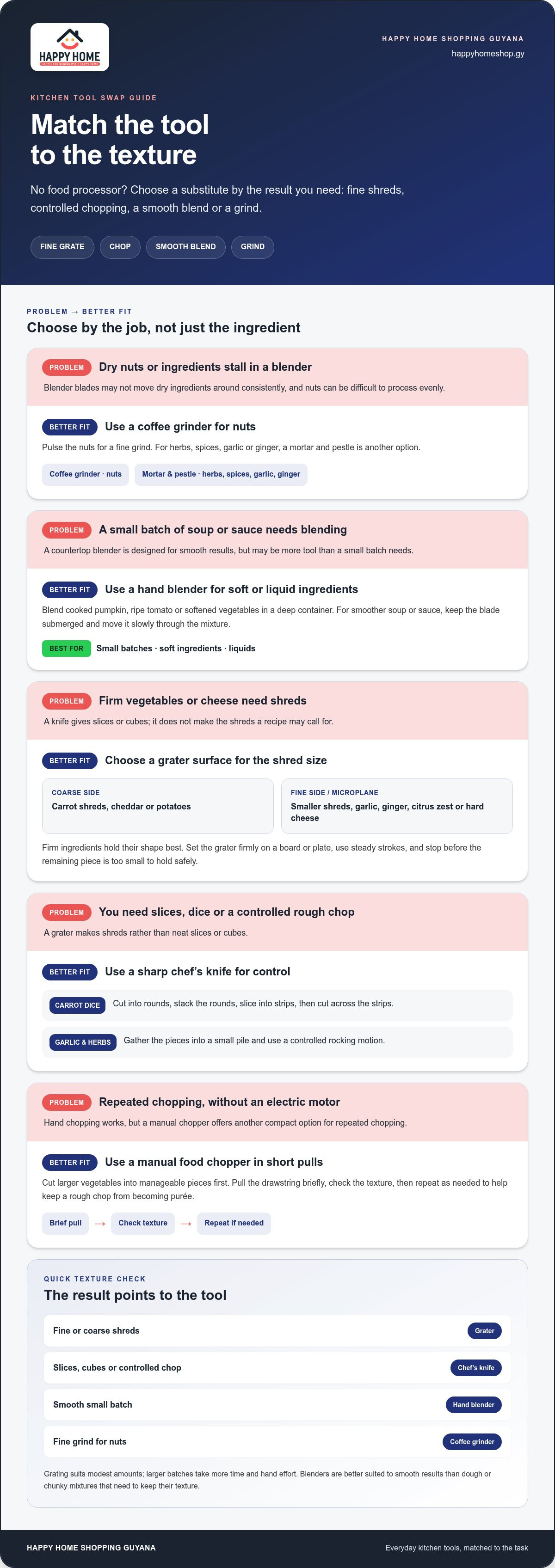
A blender isn’t always the easiest tool for nuts. If you’re deciding what to use instead of a food processor, pulse nuts in a coffee grinder or roughly chop them with a sharp knife. Blenders can struggle with dry ingredients. Choose based on the result you need: a fine grind, a smooth blend or chunky pieces.
It’s frustrating when a recipe calls for a machine you don’t have, but everyday kitchen tools can still get the job done. The best substitute depends on whether you need to grate, chop, blend or grind, and each option has limits. A box grater works for firm vegetables, while a hand blender can handle small batches of soup or sauce.
Key Takeaways
- Choose the tool by the result you need: a fine grate, a rough chop, a smooth blend or a coarse grind.
- Use a box grater or microplane for firm vegetables, cheese and finely grated ingredients, and take care to keep fingers clear.
- For nuts and dry ingredients, a coffee grinder or mortar and pestle can work better than a blender.
- Reach for a hand blender when you’re making small batches of soup, sauce or soft-ingredient purée.
- A Yusshn 12 IN 1 Vegetable Chopper can help with everyday chopping and vegetable prep.
1. Grating and finely chopping with a box grater or microplane
Choosing what to use instead of a food processor starts with the texture your recipe needs. A box grater handles firm ingredients in different ways: use its coarse side for carrot shreds or cheese, and its fine side for smaller pieces. A microplane finely grates garlic, ginger, citrus zest or hard cheese. For pastry, grate cold butter into flour to distribute it more easily. A box grater can also break nuts into flour, though the result may be less uniform than machine-ground nuts.
Set the grater firmly on a board or plate before you begin. Move the ingredient down the surface with steady strokes, rotating it to use a fresh area. With a microplane, hold the handle securely and guide the ingredient carefully across the teeth. Stop before the remaining piece is too small to hold safely. Grating suits modest amounts, but larger batches take more time and hand effort.
A sharp chef’s knife is better for chopping, slicing or dicing. To dice a carrot, cut it into rounds, stack the rounds, slice them into strips, then cut across the strips. For garlic or herbs, gather the pieces into a small pile and use a controlled rocking motion. A knife lets you control piece size, while a grater makes shreds rather than neat slices or cubes.
For small batches, a manual food chopper is another option. Some models use a drawstring to power the blade instead of an electric motor, and can chop onions or carrots. Cut larger vegetables into manageable pieces first. Pull the drawstring briefly, check the texture, then repeat as needed. This helps prevent a rough chop from turning into purée. A chopper suits repeated chopping; a knife gives you more control over slicing.
What are the best food processor alternatives for making dough? To make dough without a food processor, knead bread or pie dough by hand on a floured or oiled surface until fully mixed. A stand mixer can knead dough, while a hand mixer is better for combining liquids and solids than for working firm dough.
Which alternative is best for small kitchens or low budgets? A chef’s knife, cutting board and box grater handle chopping, slicing and grating while taking up little storage space. A manual food chopper is another compact option for repeated chopping without an electric motor.
2. Hand blenders for small batches and soft ingredients
A hand blender suits small batches of soft or liquid ingredients. Put cooked pumpkin, ripe tomato or softened vegetables in a deep container, then blend until the mixture reaches the texture you want. Its compact blade works best when ingredients can move around it easily. For smoother soup or sauce, keep the blade submerged and move it slowly through the mixture instead of lifting it repeatedly.
For a larger batch, a countertop blender can make smooth soup, sauce or purée. Cut ingredients into manageable pieces, add liquid, then blend in short bursts or use the pulse setting. This helps control consistency and avoids running the blender continuously. If the blades stop moving through dry ingredients, add a splash of liquid. Breadcrumbs and finely chopped herbs may still be difficult to process evenly, so a knife can be a better choice.
Blenders can also mince, chop or purée, but results depend on moisture and texture. Add soft ingredients in small amounts, pulse briefly, then pause to scrape down the sides if pieces stick. For homemade mayonnaise or pesto, an immersion blender can emulsify the ingredients in a tall container. A blender can also combine herbs and oil for chimichurri, though scraping the sides helps distribute the mixture. Spices and other dry ingredients may not move consistently around blender blades.
A food processor is generally more useful for chopping and handling chunky mixtures, while a blender is designed for smooth results. Choose a blender for tomato soup, pourable sauce or soft fruit purée. Use another method for dough or a chunky salad mixture. A food mill can make smooth purées and separate some pulp, seeds and fibres, making it useful for tomato sauce. Match the tool to the texture you want, not just the ingredient.
What foods should not be processed in a blender or alternative tool? Avoid using a blender for dough or chunky mixtures that need to keep their texture. Dry ingredients such as breadcrumbs and finely chopped herbs can also be troublesome because they may not circulate around the blades. Use a knife or another method suited to their texture.
Where can you buy affordable food processor alternatives in Guyana? Look for manual kitchen tools or small-batch gadgets through online kitchen retailers serving Guyana, and compare each tool’s functions with the jobs you need it to do. For a handy starting point, browse kitchen tools for everyday food preparation.
3. Box graters for cheese and vegetables
A box grater shreds firm cheese and vegetables without an electric appliance. Use its coarse surface for cheddar on baked pasta or potatoes for hash browns. The fine surface makes smaller shreds that mix easily into fritters or salads. A microplane produces an even finer result, useful for hard cheese over soup or chocolate over dessert. Match the grater’s surface to the texture your recipe needs.
For carrots, push the vegetable down the grater in steady strokes, then rotate it to use a fresh surface. Grated carrot blends into cake batter more readily than chopped pieces. Potatoes can be grated for latkes or other pan-fried dishes, but squeeze out excess moisture before mixing. Firm vegetables work best because they hold their shape against the grater. Soft or watery produce can collapse, clog the holes and turn into a wet mash.
Cheese texture depends on its firmness and temperature. A firm block is easier to guide across the grater than soft, crumbly cheese. If it smears, chill it until firm, then grate it over a bowl or board. For a small amount of parmesan, a microplane makes fine strands that melt quickly into hot pasta. Larger shreds stay distinct in a sandwich or on a casserole.
Grating differs from grinding. A box grater cuts food into strips or fine shreds, while a grinder breaks ingredients into smaller particles. Use a grater for carrots in carrot cake, cheese for a topping or chocolate curls. Use a grinder when nuts or spices need a finer, powder-like texture. A coffee grinder can handle nuts or spices in short pulses, but clean it between ingredients to avoid carrying strong flavours into the next batch.
Graters are versatile, but they don’t replace every food processor function. They won’t make uniform cubes, blend a smooth sauce or knead dough. Choose a food chopper for repeated chopping, or a knife when ingredients need neat slices. For recipes that need only grated ingredients, a box grater is straightforward and easy to store. Collect the shreds in a wide bowl, and stop before your fingers reach the grating surface.
For recipes that call for shredded produce, use a box grater or microplane for firm vegetables such as carrots or potatoes. Choose the tool and surface to suit the texture you want, keep the vegetable steady as you work, and collect the pieces in a bowl before mixing or cooking.
4. Mortar and pestle for grinding herbs, spices, garlic and ginger
A mortar and pestle gives you hands-on control over small amounts of herbs, spices, garlic and ginger. Add ingredients in manageable batches, then press and turn the pestle against the mortar’s base. For garlic paste, crush the cloves first, then grind them with a little salt. To make curry paste, work through ginger, garlic and spices gradually, adding ingredients that need more force before softer herbs.
For pesto or aioli, use a steady circular motion to break down the ingredients and bring them together. A mortar and pestle can make both, along with other pastes and sauces. Stop grinding early for a textured result, or continue for a finer one. This manual method takes longer than using an electric appliance, but it’s useful when you want direct control over texture and a compact tool that stores easily.
A coffee grinder can grind dry spices or chop nuts when you pulse them until they break down. Add a small amount, pulse, then check the texture before continuing. Short bursts help prevent the nuts from turning into paste. A coffee grinder suits dry ingredients, while a mortar handles damp garlic, ginger and herbs more readily. Clean the grinder between ingredients so strong spice aromas don’t carry into the next batch.
Choose a grinder based on what it’s designed to process. A meat grinder handles meat, while a coffee grinder can break down nuts and spices. A mortar and pestle is better suited to crushing herbs or making a small quantity of garlic paste. These tools don’t perform every food processor task: they won’t slice carrots into even pieces or mix a large batch of dough. For those jobs, use a knife, grater or another suitable kitchen tool.
Texture depends on both the ingredient and the tool. Whole peppercorns need firm pressure in a mortar, while fresh basil bruises with gentler grinding. For finely ground spices, continue pulsing in a coffee grinder, pausing to check for larger pieces. If a recipe needs a smooth paste, grind in stages rather than adding everything at once. A stand mixer attachment may handle mixing or kneading, but it won’t replace the mortar’s precise crushing action.
One tool can handle different preparations, including aioli, pesto and curry paste, making it useful for a range of kitchen tasks.
5. Food processor functions
A food processor combines several jobs, so choose an alternative by the result your recipe needs. Its blades can chop, purée and mix, while attachments may slice, shred, dice or cut hard vegetables into French-fry batons. A knife and box grater can cover basic chopping and shredding, but neither makes smooth purée. For each task, match the substitute to the finished texture rather than expecting one tool to do everything.
For diced vegetables, use a sharp knife and cut each piece to a similar size. Some food processors use dicing or French-fry attachments to make cubes or batons from hard ingredients. A knife takes more hands-on work but gives you control over the shape. For carrot cake, grate carrots by hand, then use a stand mixer with a paddle attachment to mix the batter. A stand mixer can knead, whip or grate, but may not chop or purée as efficiently as a food processor.
Soft cooked ingredients need a different approach. A food mill can make smooth mashed potatoes, soups, fruit purées, sauces or baby food. It also removes some pulp, fibre and seeds from sauces such as tomato passata. For a simple mash, cook potatoes until soft, then mash them with a fork or potato masher. A food processor can make potatoes gummy if its blades work them too much, so use it briefly and carefully.
If a recipe uses a food processor to cut butter into flour, a pastry cutter and mixing bowl can do the job for scones. Work the butter into the flour, then fold in cheese and herbs. Bread and pie dough can also be kneaded by hand on a floured or oiled surface until fully mixed. These substitutes take more manual effort, but suit recipes where texture depends on gentle handling.
Even the processor’s speed can affect flavour. Grinding at high speed creates friction and heat, which can reduce a food’s flavour. For potatoes, pulse 3-4 times for 2-3 seconds per pulse rather than running the blades continuously. That brief approach helps limit overworking while you check the consistency. The practical takeaway: use a knife for defined cuts, a mill or masher for soft purées, and hand mixing for dough. For everyday vegetable preparation, explore kitchen-prep tools.
Happy Home Shopping Guyana: Jade Leaf Matcha Organic Matcha Latte Mix
Happy Home Shopping Guyana offers Jade Leaf Matcha Organic Matcha Latte Mix for preparing a matcha drink at home, a useful pantry option alongside practical kitchen tools. For everyday vegetable prep, the Yusshn 12 IN 1 Vegetable Chopper can help with chopping tasks that might otherwise call for a food processor. These offerings serve different kitchen needs: one is a matcha latte mix, while the other is a food-preparation tool.
If you’re choosing a simple alternative for chopping vegetables, explore the Yusshn chopper; for a matcha drink, choose the latte mix. Visit Happy Home Shopping Guyana to browse these kitchen and pantry offerings.
Make Your Next Prep Choice with Confidence
Let the recipe’s final texture guide your choice of kitchen tool. Before you start, consider whether the ingredients should stay chunky, turn silky or become finely ground. That brief planning step can help you choose a tool that suits the dish rather than asking one appliance to handle every task.
If you’re deciding what to use instead of a food processor, consider the amount you’re preparing and the finish you want. A quick meal for yourself may call for a different method than a large family recipe. Keep that in mind as you plan, and you’ll have a clearer starting point for cooking.
For a practical addition to your kitchen routine, browse Happy Home Shopping Guyana. Choose what fits your home and the way you like to cook, then enjoy making the next meal your own.
Frequently Asked Questions
Can I use a blender for nuts?
Yes, but a coffee grinder is often better for dry nuts because blender blades may not pull them into a consistent grind. If using a blender, add a small batch and pulse briefly, checking the texture between bursts. Stop when the nuts are chopped; continuing can turn them into paste. For a rough topping, a knife or rolling pin gives you more control over the pieces.
What can I use instead of a food processor for chopping vegetables?
Use a chef’s knife for precise pieces or a manual food chopper for repeated chopping. For evenly sized onion or carrot pieces, cut the vegetables into similar-sized chunks before using the chopper. For a quick salad, slice each vegetable first, then gather and chop the slices to your preferred size. Use a grater when you want shreds rather than cubes.
Can I use a blender instead of a food processor?
Sometimes. If you’re deciding what to use instead of a food processor, choose a blender when the recipe needs a smooth result, such as a pourable sauce or soup. It’s less suited to dough or mixtures that should stay chunky. For a dip, add liquid gradually and pulse, then pause to scrape ingredients from the sides if needed. Choose a knife or grater for distinct pieces.
How do I chop food without a food processor or blender?
Use a sharp chef’s knife and a stable cutting board. For diced vegetables, slice the ingredient into planks, stack the planks, cut them into strips, then cross-cut the strips. Keep the pieces together as you work, and gather them into a pile if you need a finer chop. For biscuits or crackers, seal them in a bag and crush them with a rolling pin.
How do I make pesto without a food processor?
Use a mortar and pestle for a small batch. Crush garlic first, then work in the herbs and other ingredients until they form a coarse paste. Add oil gradually while grinding to bring the mixture together, and stop when it reaches the texture you like. An immersion blender can also blend pesto in a tall container; pause to scrape down the sides if herbs stick.
How do I grate or shred ingredients without a food processor?
Use a box grater for firm cheese or vegetables, choosing a coarse surface for larger shreds and a fine surface for smaller strands. A microplane works well for very fine grating, such as hard cheese over a finished dish. Hold the tool securely and guide the ingredient carefully. Stop before the remaining piece is too small to grip safely.
Can an immersion blender replace a food processor?
An immersion blender can replace some food processor tasks, especially blending soups, sauces and small-batch purées. If you’re weighing what to use instead of a food processor, consider an immersion blender for soft or liquid ingredients, such as smooth soup. It won’t create uniform pieces of firm vegetables, shred cheese or knead dough. Use a knife, grater or another suitable tool for those preparations.
